In modern cloud-native architecture, containers and orchestration are foundational concepts. Two names dominate this space: Docker and Kubernetes.
A common question arises: If Docker already existed, why did Kubernetes come into the picture at all?
To answer this, we need to look at the historical evolution of application deployment, the limitations Docker faced at scale, and how Kubernetes solved problems Docker was never designed to handle.
Before Docker: The Pre-Container Era
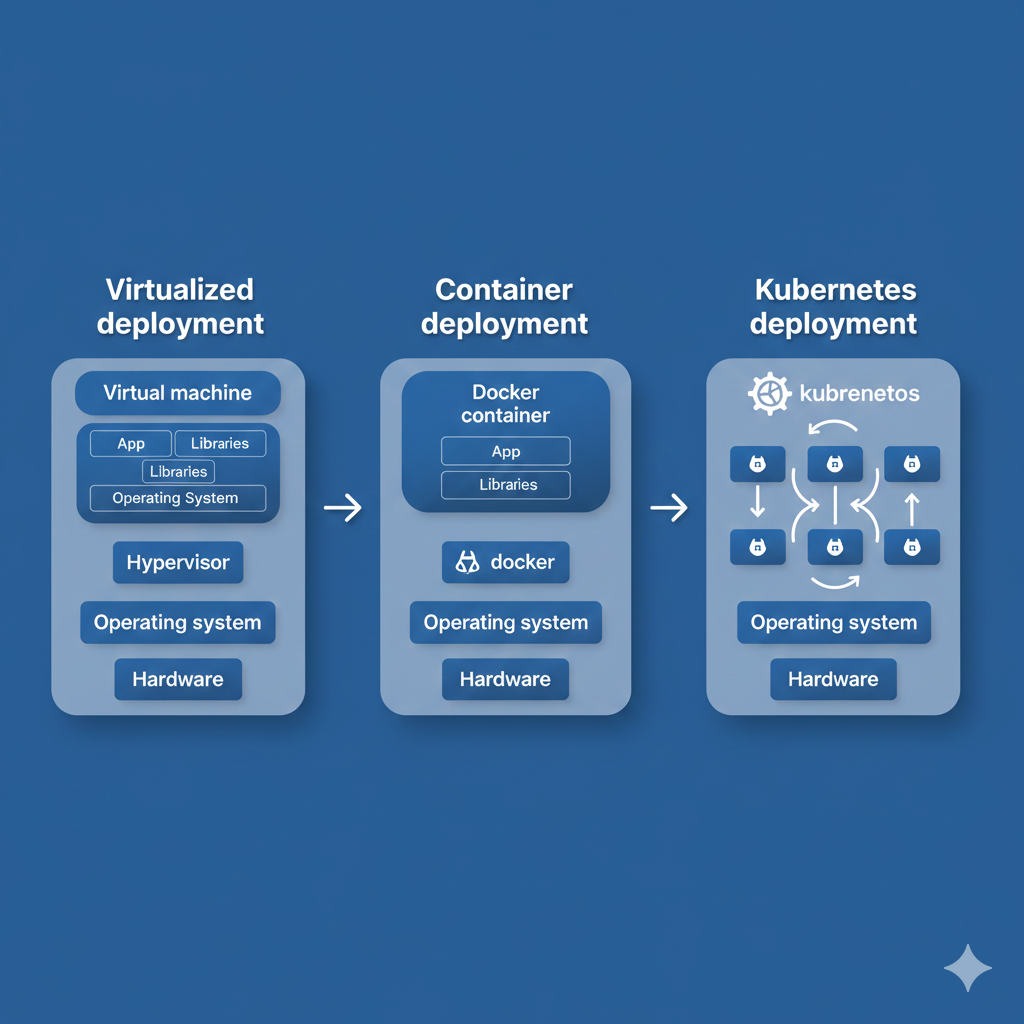
Before containers, applications were deployed in two main ways:
1. Bare Metal Servers
- One application per server
- Low resource utilization
- Difficult to scale
- Manual deployments
2. Virtual Machines (VMs)
- Hypervisors like VMware, KVM
- Each VM had a full OS
- Better isolation but heavy and slow
- High operational cost
The industry needed something lightweight, fast, and portable.
Docker’s Entry: Solving the “It Works on My Machine” Problem
Docker emerged around 2013 with a revolutionary idea:
Package an application and everything it needs into a single, portable unit.
What Docker Solved Well
- Application packaging
- Dependency consistency
- Faster startup compared to VMs
- Easy local development and CI/CD integration
A Docker container includes:
- Application code
- Libraries & dependencies
- Runtime
- Configuration
This made Docker perfect for developers.
But Docker Had Limits
Docker worked brilliantly on one machine.
Problems started when organizations tried to run hundreds or thousands of containers.
Docker alone did not handle:
- Automatic scaling
- Self-healing
- Load balancing
- Multi-node scheduling
- High availability
- Rolling updates across clusters
The Scaling Problem: Where Docker Fell Short
As companies moved to microservices, they faced new realities:
- One app → 50–500 containers
- Containers spread across multiple servers
- Servers could fail at any time
- Traffic could spike unpredictably
Questions Docker couldn’t answer by itself:
- Which container should run on which node?
- What happens if a node dies?
- How do we expose services reliably?
- How do we update without downtime?
This gap created the need for container orchestration.
Kubernetes was introduced by Google (inspired by their internal system Borg) to solve production-scale container management.
Docker builds containers. Kubernetes runs containers reliably at scale.
Why Kubernetes Was Needed
Kubernetes came into existence to handle what Docker intentionally avoided:
| Problem | Docker | Kubernetes |
|---|---|---|
| Container packaging | yes | no |
| Multi-node scheduling | no | yes |
| Auto-scaling | no | yes |
| Self-healing | no | yes |
| Service discovery | no | yes |
| Rolling updates | no | yes |
| Production orchestration | no | yes |
Docker vs Kubernetes: Different Responsibilities
Docker’s Responsibility
- Build container images
- Run containers on a single host
- Developer-focused tooling
Kubernetes’ Responsibility
- Orchestrate containers across clusters
- Ensure desired state
- Handle failures automatically
- Scale applications based on demand
They are not competitors—they are complementary.
How They Work Together
In real-world production:
Developer → Docker Image → Container Registry → Kubernetes Cluster
- Docker creates the image
- Kubernetes pulls and runs the image
- Kubernetes manages:
- Replicas
- Networking
- Scaling
- Rollouts
- Failures
Modern Kubernetes no longer depends strictly on Docker (it uses container runtimes like containerd), but Docker remains essential for building images.
Why Kubernetes Became the Industry Standard
Kubernetes succeeded because it:
- Solved real production problems
- Was open-source and vendor-neutral
- Worked across cloud providers (AWS, Azure, GCP, on-prem)
- Matched the needs of microservices and DevOps
- Automated operations traditionally done manually
Today, Kubernetes is the operating system of the cloud.
Final Summary
- Docker solved application packaging and portability
- Kubernetes solved scaling, reliability, and orchestration
- Docker came first, but Kubernetes was inevitable
- Kubernetes exists because production systems are complex
- Together, they form the backbone of modern cloud-native platforms
Docker made containers easy. Kubernetes made containers usable at scale.