Understand database replication concepts, types, and use cases including master–slave, multi-master, and clustered replication.
What Is Database Replication?
Database replication is the process of copying and synchronizing data across multiple database instances. The primary goals are high availability, fault tolerance, scalability, and disaster recovery.
Replication is a core feature across most modern relational and NoSQL databases.
Why Replication Is Important
Replication helps organizations:
- Reduce downtime
- Improve read scalability
- Enable disaster recovery
- Protect against data loss
Without replication, a single database failure can cause major service disruption.
Common Types of Database Replication
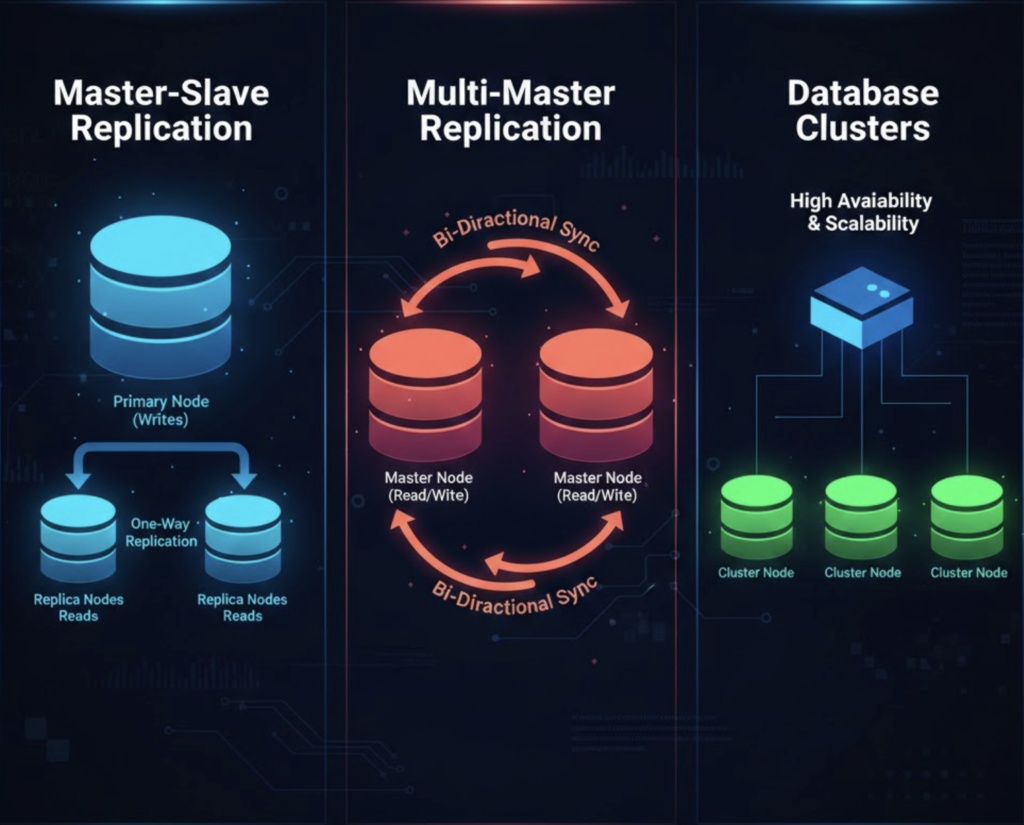
Master–Slave (Primary–Replica)
One primary database handles writes, while replicas handle reads.
Advantages:
- Simple to implement
- Read scalability
Limitations:
- Primary is a single point of write failure
Multi-Master Replication
Multiple nodes can accept write operations simultaneously.
Advantages:
- High availability for writes
- Reduced latency in distributed systems
Challenges:
- Conflict resolution
- Increased complexity
Clustered Replication
Databases operate as a tightly coupled cluster, often appearing as a single logical database.
Advantages:
- Automatic failover
- High consistency and availability
Common use cases:
- Mission-critical systems
- Financial and transactional platforms
Synchronous vs Asynchronous Replication
- Synchronous: Data is written to replicas before confirming success
- Asynchronous: Replicas are updated after the primary write completes
Each approach has trade-offs between performance and data consistency.
Best Practices for Replication
- Monitor replication lag
- Test failover procedures
- Use proper network bandwidth
- Secure replication traffic
- Document replication topology
Conclusion
Database replication is essential for resilient systems. Choosing the right replication model depends on workload requirements, consistency needs, and operational complexity.