
A Linux distribution (Linux distro) is a complete operating system built around the Linux kernel, bundled with system libraries, package managers, shells, desktop environments, and utilities. Linux distributions are designed for different use cases such as servers, desktops, cloud computing, DevOps, cybersecurity, and embedded systems.
Understanding the history of Linux distributions helps users and system administrators choose the right Linux distro based on stability, performance, support, and long-term reliability.

Origin of Linux Kernel and Early Linux Distributions (1991)
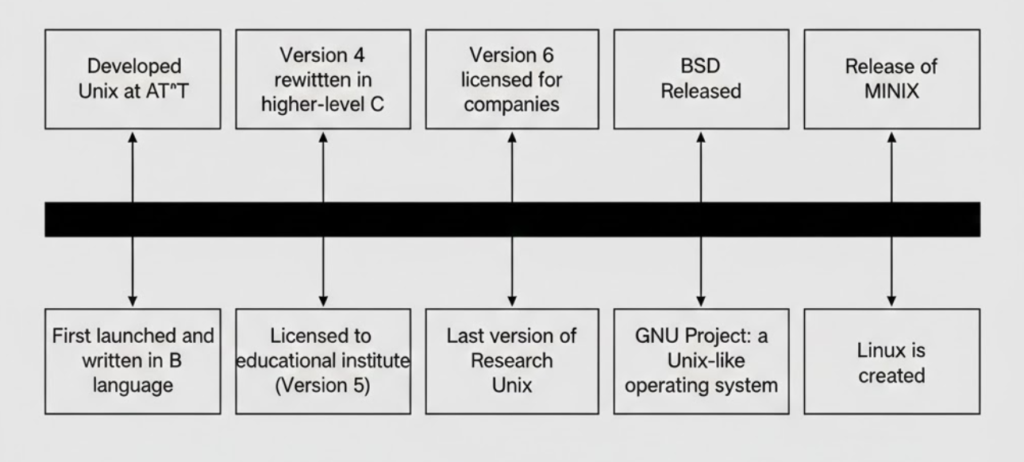
In 1991, Linus Torvalds developed the Linux kernel as a personal open-source project. At that time, Linux was only a kernel and could not function as a complete operating system.
To make Linux usable, developers combined the Linux kernel with GNU tools, Unix shells, and essential system utilities. This combination led to the creation of the first Linux distributions, transforming Linux into a functional operating system.
First Linux Distributions (1992–1994)
MCC Interim Linux (1992)
- One of the earliest Linux distributions
- Primarily used in academic environments
- Required manual installation and configuration
Softlanding Linux System (SLS)
- First widely adopted Linux distribution
- Included the X Window System
- Stability issues encouraged the development of better Linux distros
Rise of Major Linux Distributions (1993–1996)
Slackware Linux (1993)
- Oldest actively maintained Linux distribution
- Simple, stable, and closely follows UNIX principles
- Preferred by experienced Linux users
Debian Linux (1993)
- Community-driven Linux distribution
- Known for strong security and stability
- Introduced advanced package management
- Became the base for Ubuntu and many other Linux distros
Commercial and Enterprise Linux Distributions (1994–2000)
Red Hat Linux
- Focused on enterprise and business environments
- Introduced the RPM package manager
- Later evolved into Red Hat Enterprise Linux (RHEL)
SUSE Linux
- Originated in Germany
- Popular in enterprise data centers
- Introduced YaST, a powerful system administration tool
During this period, Linux gained popularity as a reliable and cost-effective server operating system.
Desktop Linux Expansion (2000–2005)
Mandrake Linux (Later Mandriva)
- Focused on desktop usability
- Simplified Linux installation for beginners
Fedora Linux (2003)
- Community-supported project sponsored by Red Hat
- Introduced cutting-edge Linux technologies
- Acts as an upstream testing platform for RHEL
Ubuntu and Mainstream Linux Adoption (2004)
Ubuntu Linux
- Based on Debian
- Developed by Canonical
- Focused on ease of use and regular release cycles
- Widely adopted for desktops, servers, and cloud environments
Ubuntu played a major role in bringing Linux to mainstream users and enterprises.
Specialized Linux Distributions (2006–2015)
As Linux matured, distributions began targeting specific use cases:
- CentOS – Free, RHEL-compatible server Linux
- Arch Linux – Rolling release and manual configuration
- Gentoo – Source-based Linux distribution
- Linux Mint – Beginner-friendly desktop Linux
- Kali Linux – Cybersecurity and penetration testing
This era demonstrated Linux’s flexibility and modular design.
Modern Linux Distributions (2016–Present)
Cloud and Enterprise Linux
- Red Hat Enterprise Linux (RHEL)
- Rocky Linux
- Alma Linux
- Ubuntu Server
DevOps and Container Linux
- Fedora CoreOS
- Flatcar Linux
- Bottlerocket
Desktop Linux Distributions
- Ubuntu
- Linux Mint
- Pop!_OS
- Zorin OS
Linux now powers cloud platforms (AWS, Azure, GCP), Kubernetes, supercomputers, and Android devices.
How to Choose the Right Linux Distribution
When choosing a Linux distribution, consider the following factors:
- Purpose (server, desktop, cloud, security, DevOps)
- Stability versus latest features
- Community support or enterprise support
- Documentation and learning curve
There is no single best Linux distribution—each Linux distro is designed to solve specific problems efficiently.

🟠 Ubuntu
Definition:
Ubuntu is a popular Linux distribution based on Debian, designed to be easy to use with strong community and vendor support.
Current Version (2026):
- Ubuntu 25.10 (“Questing Quokka”) — released October 2025, supported through July 2026.
- Upcoming / LTS: Ubuntu 26.04 LTS (“Resolute Raccoon”) scheduled for April 23, 2026, with long-term support (5 + continued security updates).
Package manager: apt (Advanced Package Tool)
Use case: Beginners, general desktop users, developers, and cloud servers.
Ubuntu offers both regular interim releases (every 6 months) and Long-Term Support (LTS) versions ideal for stability.
🟡 Fedora
Definition:
Fedora is a community-driven Linux distribution sponsored by Red Hat, known for incorporating the latest technologies and innovations in Linux.
Current Version (2026):
- Fedora Linux 43 — released October 28, 2025, with newer packages, kernel 6.17 and GNOME 49.
(A newer release like Fedora 44 is expected around April 2026 under the normal 6-month cadence.)
Package manager: dnf (Dandified Yum)
Use case: Developers, enthusiasts, and users wanting the latest open-source technologies.
Fedora’s short release cycle means frequent major versions and up-to-date software.
🟢 Linux Mint
Definition:
Linux Mint is a community-driven distribution based on Ubuntu (and indirectly Debian), designed for ease of use and simplicity, especially attractive to those coming from Windows or new to Linux.
Current Version (2026):
- The Linux Mint 22.x series (e.g., 22.3) is the latest supported release based on Ubuntu 22.04 LTS.
Package manager: apt
Use case: Desktop users, beginners, and people transitioning from Windows environments.
Mint includes out-of-the-box multimedia support and an intuitive GUI.
🔵 CentOS (CentOS Stream)
Definition:
CentOS Stream is a rolling preview distribution that tracks just ahead of Red Hat Enterprise Linux (RHEL) development, serving as an upstream testbed for future RHEL updates.
Current Version (2026):
- CentOS Stream 10 — latest release (December 12, 2024) with longer maintenance into 2030.
Package manager: dnf
Use case: Enterprise-class testing, developers preparing for RHEL environments, and stable infrastructure use with up-to-date contributions.
CentOS Stream replaces classic CentOS Linux as the primary community build tied to RHEL progress.
🔴 Red Hat Enterprise Linux (RHEL)
Definition:
RHEL is a commercial, enterprise-grade Linux distribution from Red Hat designed for reliability, long-term support, and certified workloads across servers and business systems.
Current Version (2026):
- Red Hat Enterprise Linux 10.x — the current production series with RHEL 10 released in May 2025 and point updates (like 10.1) following.
Package manager: dnf
Use case: Production servers, enterprise environments, certified applications, and mission-critical services.
RHEL offers long-term support, strong vendor support, and enterprise ecosystem integration.
From a small student project in 1991 to powering today’s cloud infrastructure and enterprise systems, Linux distributions have evolved into powerful, flexible, and reliable operating systems. Choosing the right Linux distribution enables users to fully harness the true power of open-source technology.